What does it actually mean to win the Physical AI race?
We keep asking who is winning. I'm not sure everyone is playing the same game.
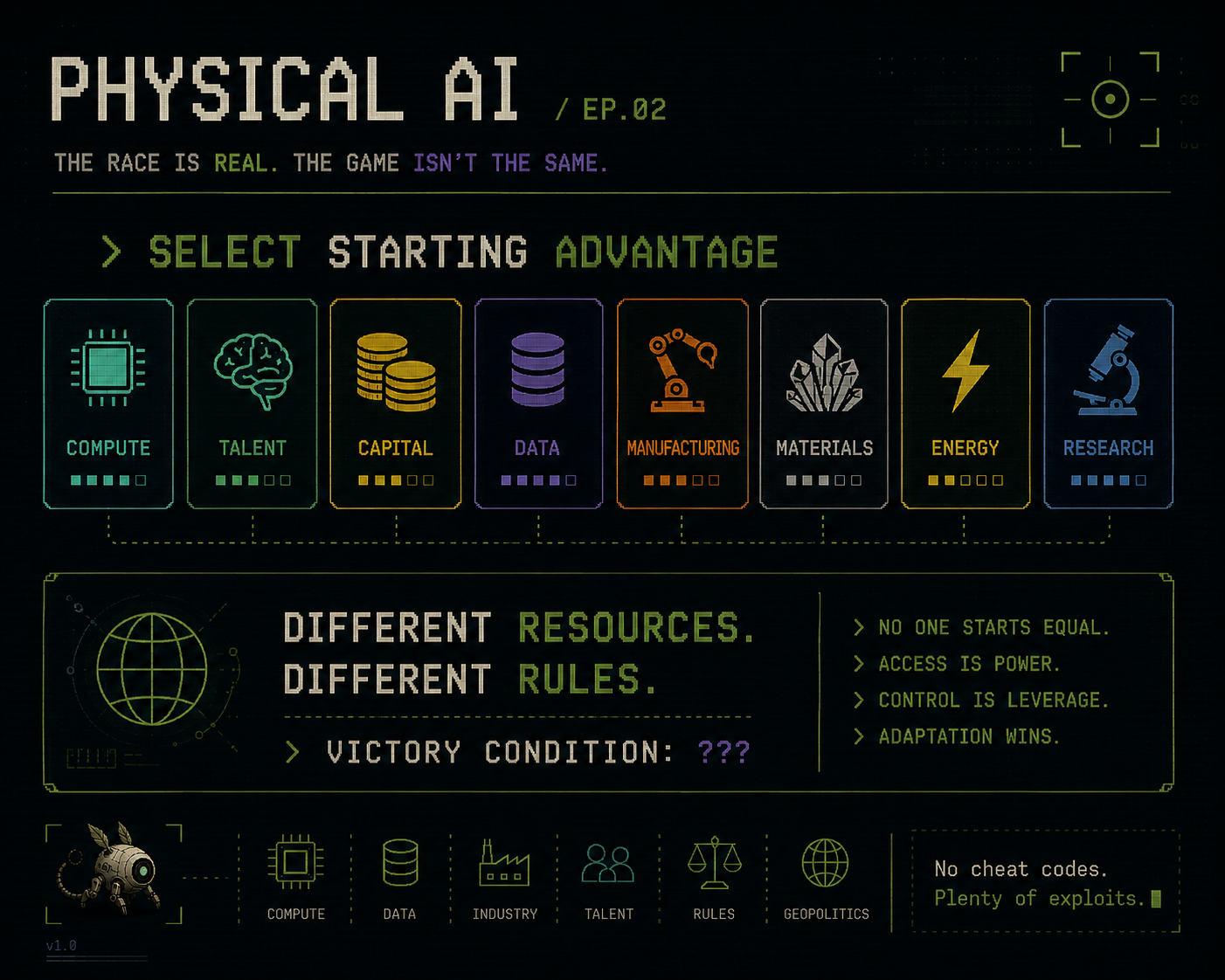
We keep asking who is winning the Physical AI race.
I'm not sure everyone is playing the same game.
We see humanoids dancing, impressive demos and enormous funding rounds. They are visible, easy to compare and extremely good at attracting attention.
But the robot is only the visible part of a much larger system.
The unit of analysis is the loop
A physical AI system does not stop at a model, a robot or a factory. It moves through a loop: sensing, acting, interacting with the physical world, generating data, learning, adapting and being deployed again.
Once that loop becomes the unit of analysis, the scoreboard changes. Compute matters. So do manufacturing, energy, materials, talent, capital, cybersecurity, validation, regulation, users and the organisations capable of deploying the system.
And the strength of one layer can be cancelled by dependence somewhere else.
Different resources. Different rules.
The United States brings extraordinary compute, capital and AI capabilities. China brings manufacturing scale, supply chains and deployment capacity. Europe brings research, industrial expertise and a different relationship with regulation, safety and validation.
Japan and South Korea bring deep robotics and manufacturing capabilities. India brings talent, software and scale. Ukraine is demonstrating, under brutal conditions, what rapid field adaptation and adversarial feedback loops can look like.
Open source crosses all of them.
But access to data is not the same. Neither are validation thresholds, risk tolerance, access to materials, energy, talent, capital or the ability to deploy systems into the real world.
A system map, not a robot ranking
A useful comparison therefore needs more than a list of companies or national robot counts. It needs to ask who controls critical resources, where the dependencies sit, which rules shape deployment and how quickly experience in the physical world can return to the system as useful learning.
Cybersecurity belongs inside that model, not around it. A connected physical system creates another feedback loop — this time with an adversary who is also observing, learning and adapting.
Humans do too. Operators improvise. Patients behave differently from test subjects. Workers route around inconvenient interfaces. Organisations create processes. Trust changes adoption. Real use generates different information from a controlled demonstration.
What if the strategic advantage is needing less?
Most technology races are narrated as races for more: more compute, more data, more energy, more capital and more infrastructure.
But efficiency can change the dependency map.
A system that can achieve useful performance with less compute may need less energy and infrastructure. A robot designed around available materials may be easier to manufacture and maintain. Models that can learn from smaller or better data may reduce dependence on access that another player controls.
Frugality and ecodesign are therefore not only environmental questions. Under the right conditions, they can become economic, resilience and sovereignty strategies.
What does winning mean?
Even after mapping the system, one problem remains: the players may not share the same victory condition.
Is winning measured in productivity? Strategic autonomy? Defence capability? Scientific progress? Industrial value? Export power? Quality of life? The ability to deploy safely in hospitals and public infrastructure?
A country optimising for military adaptation may build a different loop from one optimising for industrial productivity. A company optimising for market share may make different dependency choices from a state optimising for strategic autonomy.
So perhaps the interesting question is not who has the best robot.
That question is harder to put on a leaderboard.
It is also probably closer to the real race.
Disagree with the analysis? Working on something related? Have research, field experience or another perspective worth considering?
Get in touch →Ideas, systems and the occasional unexpected connection.
Get the next Cigrue article by email.
New articles only. No spam. Unsubscribe anytime.