Europe has the pieces. Can it build the system?
Europe already has many of the components needed for Physical AI. The challenge is turning them into a system that can scale.
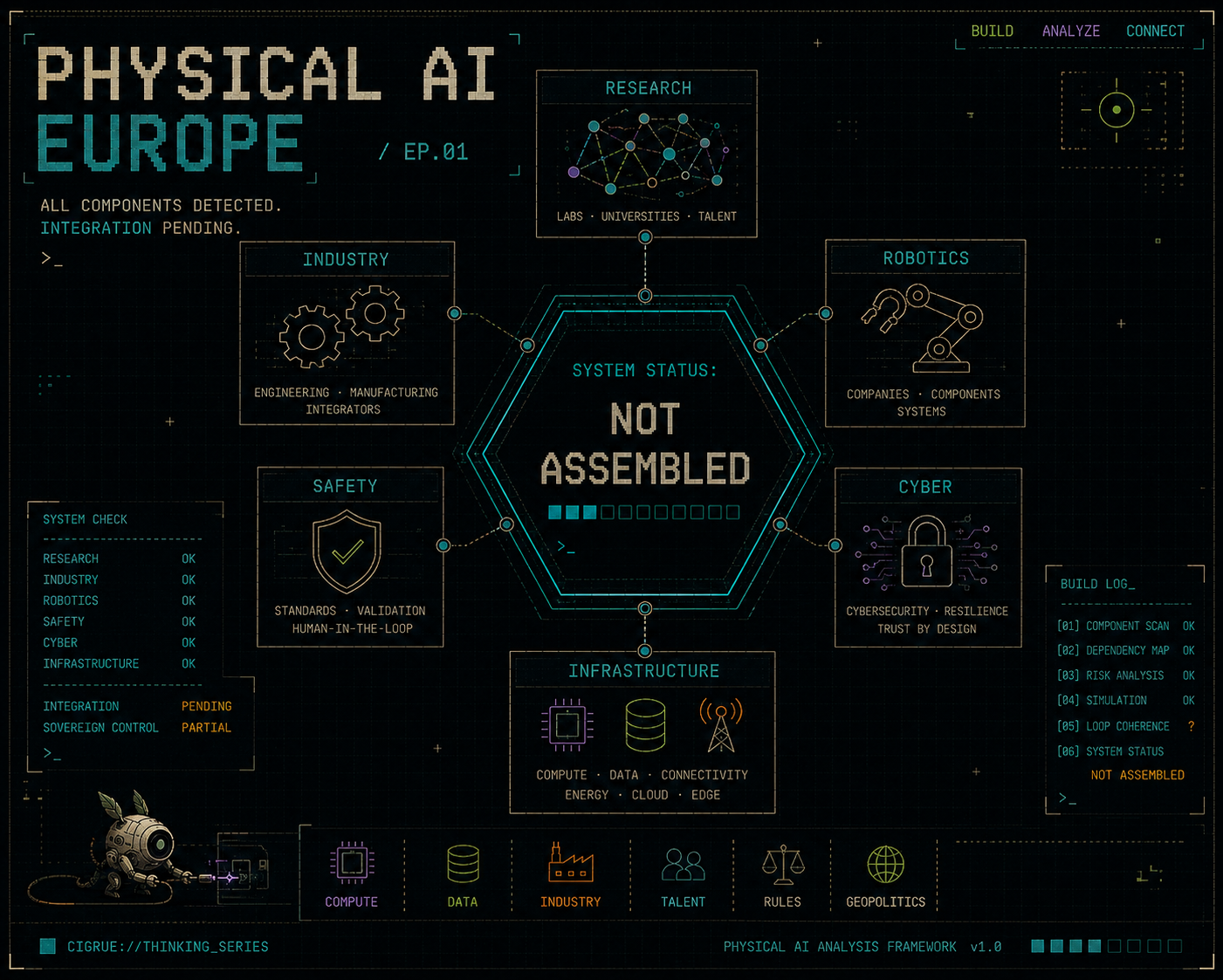
I've been looking at Europe's position in Physical AI.
Counting robots doesn't tell the whole story.
Which is mildly inconvenient. It would make the analysis much quicker.
The US has capital, compute and a powerful AI ecosystem. China is building real-world infrastructure to train and deploy robots. Korea is combining robots, components, data and manufacturing. Taiwan has an extraordinary semiconductor ecosystem. India brings engineering talent, scale and a huge domestic market.
Europe is playing a different hand.
And it's a pretty good one.
We have world-class research, strong industrial engineering, robotics companies, manufacturers, demanding end users, testing facilities and deep expertise in safety and cybersecurity.
More importantly, some of those pieces are already coming together.
We have European players such as Mistral working further down the stack, on models and sovereign AI infrastructure.
NEURA Robotics and Bosch are working together on humanoid robotics, industrial deployment and real-world data.
The euROBIN project is connecting robotics research, industry, software, data and expertise across Europe.
SPRIND - Bundesagentur für Sprunginnovationen is putting serious money behind modular, interoperable robotics built around physical use cases.
Even the regulatory picture leaves room to experiment through sandboxes and real-world testing.
So the question is no longer whether Europe can “catch up”.
It's how we turn these assets into scale.
How does excellent research reach factories, hospitals or infrastructure faster?
How do industrial partnerships create foundations others can build on?
How do we make safety, cybersecurity and trust part of the engineering advantage rather than an administrative layer added at the end?
That's where I think the European Physical AI opportunity gets really interesting.
We already have many of the components.
Now comes the systems engineering.
And, as every engineer eventually discovers, having all the right components on the table doesn't mean you've built a working system.
Sometimes you've just built a very expensive table.
- Mistral AI — In-region inference, open models, and new European infrastructure for sovereign AI
- NEURA Robotics — NEURA Robotics and Bosch partnership for humanoid robotics
- European Commission / CORDIS — European ROBotics and AI Network (euROBIN)
- SPRIND — Next Frontier Robotics
- European Union — AI Act: regulatory sandboxes and real-world testing
- International Federation of Robotics — Robot Density Surges in Europe, Asia and the Americas
Disagree with the analysis? Working on the problem from another perspective? Have research or field experience that changes the picture?
Get in touch →Ideas, systems and the occasional unexpected connection.
Get the next Cigrue article by email.
New articles only. No spam. Unsubscribe anytime.